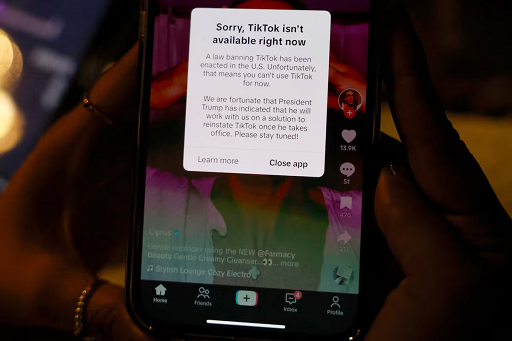
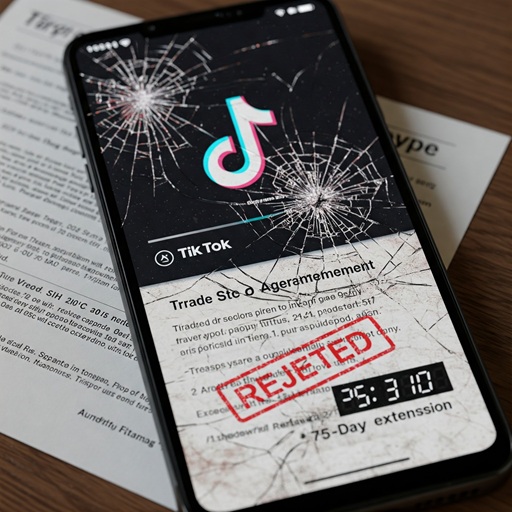
On Friday, April 4th, Trump announced that the 'final deadline' for TikTok's operations in the United States would be extended by another 75 days, reportedly because the mutually agreed-upon deal has not been approved by the Chinese government.
1. The TikTok Dilemma: More Than a Deal, It’s About Digital Sovereignty
The negotiations between TikTok’s parent company, ByteDance, and American companies were initially framed around security and data privacy concerns. However, from the Chinese government’s disapproval, it is evident that the core issue is no longer a business deal but an expression of digital sovereignty.
The Main Obstacle: Approval from the Chinese Government
As a Chinese tech company with global influence, TikTok's core algorithms, data models, and content distribution mechanisms are considered “strategic assets” by the Chinese government. According to China's "Technology Export Control Regulations," exporting technologies such as TikTok’s personalized recommendation algorithm requires government approval.
From this perspective, no matter how high the offer or how attractive the deal, if the transfer of core technology is involved, the Chinese government is likely to veto the deal due to national security and sovereignty concerns. As one Chinese state media commentary put it: The “red line” in the TikTok deal is not the price, but the fundamental issue of control.
2. What Does Trump's 75-Day Extension Mean?
Trump’s decision to extend the TikTok trade deadline by another 75 days is a strategic move, and it’s much more than just "buying time."
Time to Create Space: The Trump administration may be waiting for domestic political clarity, increased international pressure, or changes in market conditions to negotiate from a more advantageous position.
Strategic Buffering: It also serves as a way to ease market panic and stabilize public sentiment. Immediate actions like a ban or forced trade could have negative repercussions.
Shifting Blame: If negotiations fail after 75 days, the US could shift the blame onto China, stating that the failure was due to China's disapproval, thus legitimizing future policies and reinforcing public support.
Therefore, this 75-day window serves as both a negotiation period and a critical observation point for how the US reassesses its platform governance strategy.
3. Safety Concerns Unresolved: Even if the Deal Happens, Is TikTok Truly Safe?
Even if the deal somehow goes through, is TikTok really "safe"? The answer is likely not as simple as it seems.
Even if the Deal Happens, TikTok's Safety Issues Remain Doubtful
The US government has shown little faith in “structural separation” or “data localization” proposals. Even if TikTok is taken over by US companies or an independent board is established, issues such as the source code, engineering team, and update mechanisms still raise red flags for security agencies.
Former National Security Advisor to the White House once stated: "The issue with TikTok is not just who owns it, but what system it runs on, where it operates, and who controls it."
This leads to the question: What the US may really want is not just a division of the platform, but a full technological takeover.
4. Apple and Google’s Continued Service to TikTok: Are They Violating the Law?
On Friday, Raja Krishnamoorthi, the chief Democratic member of the House Special Committee on China and co-author of the TikTok bill, stated that further delays should not be tolerated. “Bidders are waiting, and time is running out. No more excuses. It’s time to enforce the law and save TikTok now,” he said.
While the executive order allowing TikTok to continue operating has faced some criticism, it has not been challenged in court. Legal experts suggest that such a challenge is unlikely, mainly because plaintiffs would struggle to meet the legal standing requirements—specifically, they must prove actual harm caused by the delay.
Sarah Kreps, director of Cornell University’s Institute for Technology Policy, expressed doubts that anyone could meet that requirement. “If the platform were gone entirely, that would be a different story,” she said. “But if the status quo remains, it’s a different situation.”
Chris Pierson, CEO of cybersecurity and privacy protection platform BlackCloak, pointed out that if ByteDance still controls the algorithm, a foreign adversary still manages the data and could use it for other purposes. “The core issue is control over data and algorithms,” he stated. Pierson, who previously worked on the DHS Privacy and Cybersecurity Committees for over ten years, added, “If these two elements remain unchanged, then the essence of the deal hasn't shifted, and neither have the risks.”
Under the law, a 90-day exemption can be granted if there is an agreement and formal notification to Congress. Alan Rozenshtein, associate professor at the University of Minnesota, believes Trump’s current approach violates the law.
5. Public Opinion in the US: Should TikTok Be Banned?
As the government debates, public opinion remains divided on whether TikTok should be banned.
l Supporters of the ban argue that TikTok is a "tool of Chinese influence," with concerns over teen addiction, data leakage, and the manipulation of public opinion.
l Opponents of the ban contend that it is an infringement on freedom of speech, driven by a form of technological nationalism. They worry that banning TikTok could set a dangerous precedent for government intervention in online content.
A recent poll shows that support for “regulation but not a full ban” is growing, indicating that the public is beginning to understand the complexity of the issue and is becoming more wary of a blanket policy.
TikTok Creators’ Voices: Creators Struggling with Uncertainty
TikTok creators are also feeling the impact of this uncertainty. Terrell Wade, a content creator with 1.5 million followers, has been actively working to expand his influence on other platforms since January.
He said: "I'm happy about the extension, but honestly, going through this whole process again is a bit exhausting. Every time a new deadline comes, it no longer feels like a real threat; it’s more like background noise. That doesn’t mean I’m ignoring it, but it’s hard to respond with the same urgency every time."
Terrell has continued to be active on Instagram, YouTube, and Facebook. For him, the future of TikTok remains uncertain, but he is forced to wait for a final outcome.
“I just hope we can get a clearer result soon, so creators like me and ordinary users can focus on other things, rather than constantly wondering ‘what if.’” he said.
These creators' voices highlight an important dimension: not only is the uncertainty creating anxiety within government circles, but it is also deeply affecting content creators, who wish for some stability and clarity.