YouTube has brought another piece of good news to creators! This time it is not advertising revenue sharing or membership rewards, but a new revenue model designed specifically for educational content - the Player for Education program.
You may not have heard of this term yet, but if your videos have educational elements, or if you make Shorts, it is worth taking a good look at this new project because:
It may allow your videos to generate revenue without ads!
What is YouTube "Player for Education"?
YouTube recently updated a program called Player for Education, which aims to improve the playback experience of educational content in teaching scenarios.
Main features:
Ad-free playback: optimize students' concentration and improve learning efficiency;
Enhanced privacy protection: Comply with the data protection standards of educational institutions;
Embedded in teaching platforms: Schools, educational institutions or teachers actively choose to embed content into teaching materials or teaching platforms.
The most important thing is:
Even without ads, creators still earn revenue! The money comes from player licensing fees paid to YouTube by education partners.
How do creators earn income through this program?
YouTube said in its announcement:
"Once you accept the "Education Player Payment Terms", your educational content will be embedded in schools or educational platforms, and you will receive a share of the revenue based on the viewing time of the video in the player."
Core Mechanics:
Education partners (schools, education platforms, etc.) pay licensing fees to YouTube for use of the player;
YouTube then divides the revenue based on the total monthly viewing time and distributes it to the relevant creators in proportion.
Not relying on advertising, but relying on sharing of licensing fees, it is a brand new monetization channel!
How to participate in the "Player for Education" benefit program?
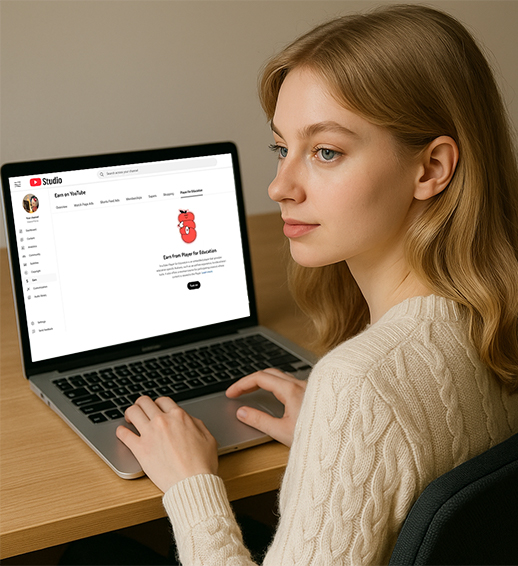
YouTube has added a dedicated section called "Player for Education" to the "Earn" tab of YouTube Studio.
Here are the steps and instructions for joining:
Step 1: Confirm whether your content type is suitable
Suitable types include but are not limited to:
Knowledge explanation videos (such as mathematics, English, programming, etc.)
Educational Shorts (Short Videos)
Skill teaching (such as drawing, science experiments, writing training)
Study strategy sharing, exam skills, etc.
Step 2: Log in to YouTube Studio
1. Open YouTube Studio
2. Click the [Earn] page in the left navigation bar.
3. Check if the Player for Education tab appears
If this feature is not yet available to you, you can continue to pay attention to the channel analysis data and increase the proportion of educational content. YouTube will gradually open this feature based on the content attributes.
Step 3: Accept relevant agreements
After clicking into the "Player for Education" tab, if you are eligible for revenue, the system will prompt you to agree to the relevant terms. After reading and confirming, you can participate in the profit sharing.
How to make your videos more easily embedded in educational projects?
Want to catch this wave of bonus express? Here are some suggestions for reference:
1️. Focus on "highly practical" educational content
Subject knowledge: such as K12 courses such as mathematics, physics, and chemistry;
Skill teaching: such as programming, painting, foreign languages, and writing skills;
Popular science explanations: such as AI knowledge, historical events, financial common sense, etc.
2️. Keep the content "clear, professional, and structured"
Educational institutions prefer videos with clear logic, accurate language, and reasonable illustrations.
3️. Add "education" related tags and categories
Correctly categorizing videos when uploading them and adding education-related tags will help the system identify them as educational content.
4️. Consider making English subtitles or bilingual videos
YouTube targets the global market, so English educational content has a greater chance of being used.
What does it mean for educational content creators?
Although this initiative is still in its early stages, it has great potential for the future:
Content is an asset: The more high-quality educational content is embedded in the classroom, the more stable the long-term benefits will be;
Encourage niche educational content: niche areas such as art, psychology, and environmental protection also have the opportunity to gain benefits;
Reverse content transformation: Encourage more creators to try the "practical + knowledge" content production path.
Which creators are suitable for this type of content?
Although not all channels can benefit, the following types of creators are particularly suitable:
Knowledge channels: such as history, science, finance, culture, etc.
Skill tutorials: such as programming, painting, photography, language learning
Shorts explanation videos: If you use short videos to share knowledge
Youth/student-oriented content: content suitable for inclusion in school curriculum
You may even have been selected for the program and just haven't opened YouTube Studio to check it out yet!
Conclusion
Although not all content creators can benefit from this program immediately, for creators with educational content genes, this is an opportunity worth investing in advance.
YouTube has paid out more than $70 billion to creators in the past three years. The platform remains one of the most profitable channels for content creators.
Would you like to try to produce and publish knowledge education content?