In the past two days, we have come to the attention of a review report on Apple's App Store called Rotten Ratings: 24 Hours in Apple's App Store. The report was produced by a researcher in collaboration with two child protection organisations, Heat Intiative and Parents Together Action.
Part 1
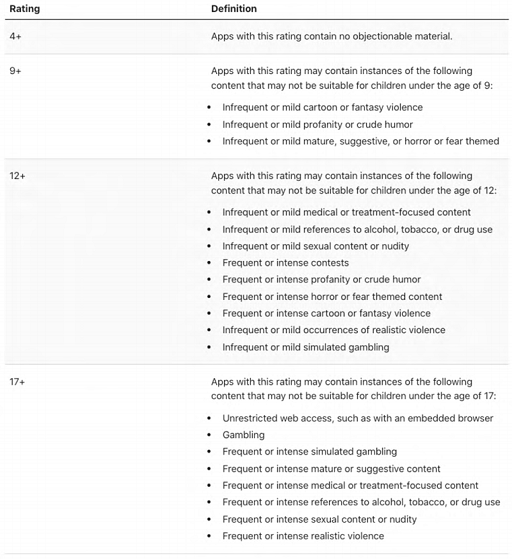
It is worth mentioning that since there are nearly 2 million apps in the Apple Store, within a limited 24 hours, they focused on several types of apps in the App Store that have historically posed a safety risk to children. These include chat apps, beauty apps, weight loss and diet apps, game apps, and Internet access apps. In total, they reviewed nearly 800 apps during the time frame and found that 200 of the apps rated "suitable for 4, 9, or 12" were at risk for children, with content that far exceeded the age rating of the Apple Store, and most of the apps rated 17+ in certain categories, such as stranger chat apps and gaming apps. Weight-loss apps and Internet access apps were also almost all rated 4+, and the potential harm to children did exist in these apps, indicating a flaw in Apple's rating system.
What is more noteworthy is that according to the statistics of the report, the total downloads of these more than 200 at-risk applications have exceeded 550 million times. For each category, the largest number of applications downloaded is beauty and body related applications, with a total of 75 applications, and a total of 210 million downloads. The others are sorted according to the number of downloads: Games (52 apps, 250 million downloads), Internet access apps (40 apps, 291 million downloads), chat apps (25 apps, 370 million downloads).
Part 2
According to the report, we summarized the core problems of these "hard-hit areas" application types and some product examples. After investigation, we found that the applications listed were basically common applications in different vertical categories (some of which we have done in-depth analysis), and did not deliberately guide children to do some dangerous actions. It is only because it does not make strict restrictions on age in particular, coupled with Apple's rating review as 4 years old +, which increases the probability of risk to children and minors. In summary, in the application of their own age restrictions, functional design and copywriting/picture publicity, I hope that Chinese practitioners can pay more attention to play a warning role, in the context of increasingly strict overseas supervision, more attention should be paid to application safety, so as to avoid being removed, banned and a series of potential problems.
①Beauty apps: Some encourage 4-year-olds to fast for 20 hours a day and set calorie goals for hunger levels, while others simulate cosmetic surgery and rate girls' appearance and "sexiness" on a scale of 1-10. Here is a partial list of typical applications:
Beauty filter apps: (These apps are at risk of channeling appearance anxiety and encouraging cosmetic surgery) :
1.Body Tune Photo Editor(9+)
2.Face and Body Photo Editor Pro(4+)
3.Starlight:Lip Filler,Retouch(4+)
4.Glow Up Photo Editor(4+)
Diet application: (Guide body anxiety, unscientific weight loss, fasting)
1.Lose It!Calorie Counter(4+)
2.Lose Weight at Home in 30 Days(4+) 3.YAZIO Calorie Counter&Diet(4+) 4.Intermittent Fasting Tracker(4+)
Appearance rating App: (Guide appearance anxiety)
1.Face Rating-AI Beauty Scan(4+)
2.Umax:AI Face Rating for Girls(9+)
3.Glowup-Face Score,Skincare(4+)
4.LooksMaxxing:Face Rating(4+)
② Game applications: Include some games with "exciting" functions, such as launching player challenges, including "complete a sexy photo", "violent games" and other types (the list of games is more vertical and targeted).
The list is:
1.Exposed 2-Party Lab Edition(12+) 2.Tap Roulette Shock My Friends(4+) 3. Draw Happy Police:Trivia Game(4+) 5 Second Rule Adult Party Game(4+) 5 Second Rule:Party Cards(9+) Party Circle:Game for Friends(12+)
1.Gun Simulator-Shake to Shoot(12+)
2.One Shot Kills(12+)
3.Sniper Killer-Assassin Game(9+)
4.Sniper Gun War-City Survival(12+)
Crime Games:
1.Mob Wars LCN:Underworld Mafia(12+)
2.Drugs Empire:Mafia Tycoon(12+)
3.Drug Mafia Weed Simulator Game(12+)
4.Underworld Empire(12+)
5.Grand Hustle:Criminal Online(12+)
③Internet access applications: These include applications that promote activities in schools, as well as some banned websites, which can be set up through filters so that these banned websites can be viewed again. The list is:
1. Vpn-fast VPN Super (4+) - VPNS are listed for their ability to bypass the school's Internet filters and firewalls, allowing them to access banned websites.
2. Vpn-unlimited Best VPN Proxy (4+)
④Chat APP: Stranger chat APP, anonymous chat APP and AI chat app are the three major disaster areas, especially the artificial intelligence girlfriend, which has had a very tragic outcome overseas, and is a more sensitive application type for minors and children who are not yet mature. The list includes:
Stranger chat app:
1.Renz-Make New Friends (12+)
2.Slowly-Make New Friends (12+)
3.SoulChill-Voice Chat and Party (12+)
4.JustTalk Kids-Safe Messenger (4+) - In a number of apps featuring children's safe chat, but users reported multiple ads, adults mixed in, among them, pedophilia and other issues, after the Apple Store intensified scrutiny, the age limit changed from 4+ to 9-11, but the above problems still exist.
Anonymous chat app:
AI chat app:
1.Chatster AI-Writing&Images(4+)
2.AI Chat4.0:Genius(4+) 3.Debra AI Girlfriend Simulator(4+)
According to our investigation, Heat Intiative raised questions about Apple Store ratings in 2023, when Apple unexpectedly dropped its iCloud CSAM (Child Pornography and Abuse) detection tool, which it announced in mid to late 2021. In response to Heat Intiative's questions, Apple's director of User Privacy and Child Safety said that the tool scans each user's stored iCloud data, creating new data security issues that have not yet been properly addressed.
So, how should we solve the problem of application risk for children and minors? At the end of the report, Heat Intiative and Parents Together Action offer several suggestions for Apple, third-party service providers, etc.
For Apple,
First, establish a third-party review. Before making apps available to children, Apple should conduct independent third-party review and verification, such as an age rating based on an expert assessment of the risks children face, rather than based on the best interests of Apple or the app developers;
Second, the rating process is transparent. There is also a need for clear guidelines based on expert advice and for the process to be transparent.
Third, regularly check the authenticity of age ratings to ensure and quickly correct inappropriate ratings, and take action against developers who try to circumvent the rating system.
Finally, strengthen parental supervision and only allow child users to view and download apps that are appropriate for their age.
For third parties, it is necessary to pay attention to the three major items of in-app advertising, data privacy sharing policy, and in-app purchase, and carefully examine the potential problems among them.
In summary, the above recommendations made by the report are indeed very targeted, and are also from the past to the present, some of the "deep-rooted" problems of the application. However, in terms of the cost of solving the problem, the possibility of implementation is still questionable, such as how to ensure the professionalism and trust of experts? Is it unrealistic to need human resources for regular checks? In addition, the lack of parental supervision, third-party advertising, and the review of privacy policies are also "vulnerability gathering places", at least in the several applications we have recently focused on dismantling, and the removal of several head applications some time ago, we can see that these problems still need to be solved.